Click and drag to move the item around. To zoom into the item, shift and scroll.
earthenware Anthropomorphic head
Maitum, Sarangani
5 B.C.- A.D. 370
Palayok Gallery
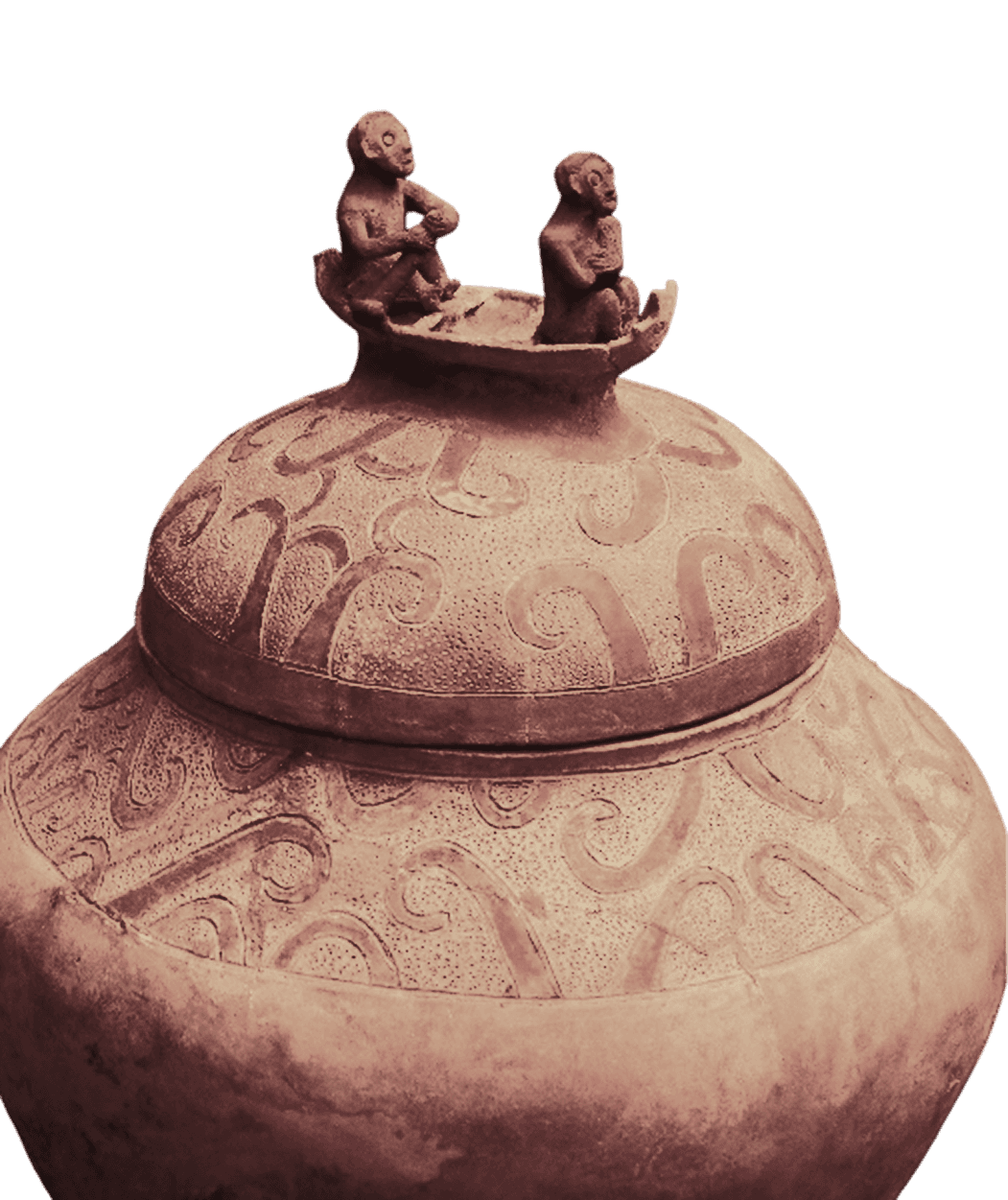
The anthropomorphic burial jars were discovered in 1991 in the Ayub cave site in Maitum, a province of Sarangi. The Maitum head is described as, “A remarkably gentle face, rendered palpable by its soft lips and tender eyes. Rather atypical compared with the other heads.” It is round, with a flat bottom. It has molded eyebrows, long rounded eyes, a round nose, and thick lips. It also has big ears, with two holes in either ear, the ear reaches the eyebrow to the mouth.
These burial jars have faces carved out are portraits of distinct individuals who are dead and represented in the jars where their remains are, which appear in many pots that were excavated in 14th century sites in Calatagan, Batangas.
Bacong has been known to archaeologists as a significant Metal Age site (between 2500 to 1000 BP) as early as the 1970s, when treasure hunters initially discovered the graves and sold them as “antique objects” looted from the sites. To stem the loss of information through pillaging during that period, archaeologists from Silliman University led by Lionel Chiong, and the University of San Carlos led by Rosa C.P. Tenazas eventually excavated some of the jar burial sites.
The stylistic presentation or production of these potteries has shown correlation to the daily activities of the ancient inhabitants in the area. Information on the relationship between the pottery variability and social organization could be attained through intensive analysis of these material evidences. However, information on gender related issues of this Metal Age society does not appear to be strong and need further investigation.
References:
Eusebio, D. & Santiago, R. (1996). Faces of Maitum. (This book is available in the National Museum Library.)
BAGO-BAGO MUSEO
Bago-Bago Museo is a national digital museum, with 360° photogrammetry models. Our goal is to help foster a space of knowledge and linking our past and our present. We are currently hosting artifacts from the National Museum of Anthropology, under Salinlahi-Bago Galeriya.
QUICK LINKS
Gallery
About Gallery
About Us
CONTACT
Aiken Marquez
Email: 202201080@iacademy.edu.ph
Phoebe Dacayo
Email: 202201084@iacademy.edu.ph
Rania Pucan
Email: 202201112@iacademy.edu.ph
Chloe Villania
Email: 202201004@iacademy.edu.ph
This is a capstone project for iACADEMY (SY 2025-2026) for Multimedia Arts and Design
To click, drag, and zoom in, use two fingers.
earthenware Anthropomorphic head
Maitum, Sarangani
5 B.C.- A.D. 370
Palayok Gallery
The anthropomorphic burial jars were discovered in 1991 in the Ayub cave site in Maitum, a province of Sarangi. The Maitum head is described as, “A remarkably gentle face, rendered palpable by its soft lips and tender eyes. Rather atypical compared with the other heads.” It is round, with a flat bottom. It has molded eyebrows, long rounded eyes, a round nose, and thick lips. It also has big ears, with two holes in either ear, the ear reaches the eyebrow to the mouth.
These burial jars have faces carved out are portraits of distinct individuals who are dead and represented in the jars where their remains are, which appear in many pots that were excavated in 14th century sites in Calatagan, Batangas.
Bacong has been known to archaeologists as a significant Metal Age site (between 2500 to 1000 BP) as early as the 1970s, when treasure hunters initially discovered the graves and sold them as “antique objects” looted from the sites. To stem the loss of information through pillaging during that period, archaeologists from Silliman University led by Lionel Chiong, and the University of San Carlos led by Rosa C.P. Tenazas eventually excavated some of the jar burial sites.
The stylistic presentation or production of these potteries has shown correlation to the daily activities of the ancient inhabitants in the area. Information on the relationship between the pottery variability and social organization could be attained through intensive analysis of these material evidences. However, information on gender related issues of this Metal Age society does not appear to be strong and need further investigation.
References:
Eusebio, D. & Santiago, R. (1996). Faces of Maitum. (This book is available in the National Museum Library.)
Related Artifacts:
BAGO-BAGO MUSEO
QUICK LINKS
CONTACT
Aiken Marquez
Email: 202201080@iacademy.edu.ph
Phoebe Dacayo
Email: 202201084@iacademy.edu.ph
Rania Pucan
Email: 202201112@iacademy.edu.ph
Chloe Villania
Email: 202201004@iacademy.edu.ph
This is a capstone project for iACADEMY (SY 2025-2026) for Multimedia Arts and Design
Bago-Bago Museo is a national digital museum, with 360° photogrammetry models. Our goal is to help foster a space of knowledge and linking our past and our present. We are currently hosting artifacts from the National Museum of Anthropology, under Salinlahi-Bago Galeriya.