Click and drag to move the item around. To zoom into the item, shift and scroll.
Red-slipped Earthenware
Batanes, Cagayan
4300 BC - 2000 BC
Palayok Gallery
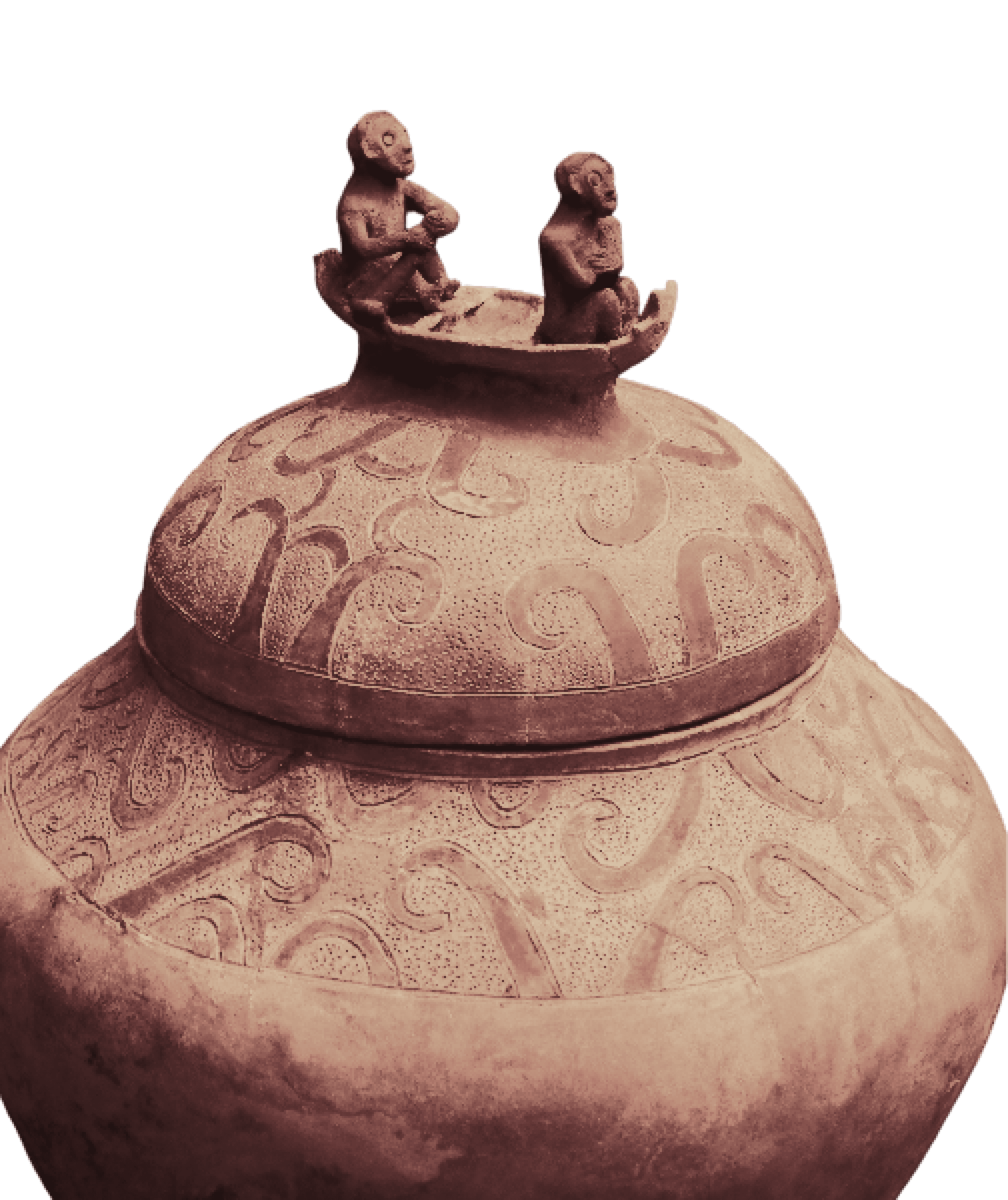
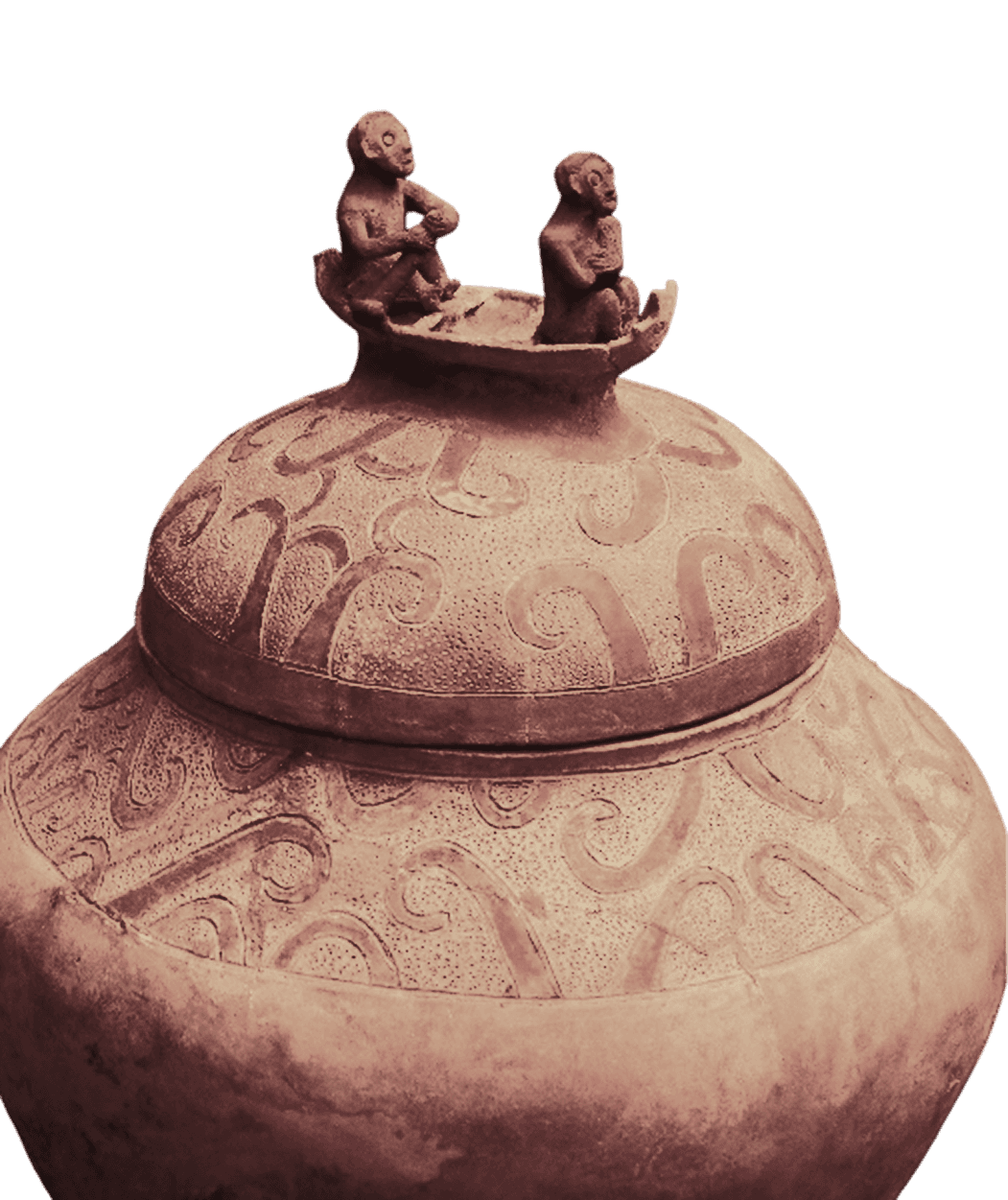
Red-slipped earthenware in the Philippines dates back during the Neolithic period where it is used to store food or liquid, cook, and serve. It is described as red clay slip, stamped, or cord-impressed designs. The collection comprises whole and fragmented ceramic vessels acquired through archaeological excavations, donations, purchases, and confiscation that commenced across the country in the 1950s. As a whole, the collection includes significant assemblages that exhibit diversity in form and decoration across the Philippine Islands through time. Typical vessel forms include globular pots, footed dishes, and bowls, with variations depending on space (sites and regions) and time (chronological period).
These Neolithic artifacts were said to be recognized as Austronesian (a language family previously known as Malayo-Polynesian group of languages that spread across Mainland and Island Southeast Asia) due to the archaeological evidence that they inhabited Batanes in early settlers, as it is accumulated from Torongan Cave and Reranum Rockshelter in Itbayat Island, Batanes. Therefore, studies made by Hidefumi Ogawa, Peter Bellwood, Eusebio Dizon, and Hsiao-chun Hung shed light on the Austronesian occupation of Batanes Islands with their Neolithic culture. MoreoverThe most westerly Pacific island chain, running from Taiwan southwards through the Philippines, has long been central in debates about the origins and early migrations of Austronesian-speaking peoples from the Asian mainland into the islands of Southeast Asia and Oceania. Focusing on the Cagayan Valley of northern Luzon in the Philippines, the authors combine new and published radiocarbon dates to underpin a revised culture-historical synthesis. The results speak to the initial contacts and long-term relationships between Indigenous hunter-gatherers and immigrant Neolithic farmers, and the question of how the early speakers of Malayo-Polynesian languages spread into and through the Philippines.
These and other vessels from the Earthenware Collection help archaeologists understand ancient societies in the Philippines by providing information on the movement of population, trade and maritime interactions, socio-political structures, cultural identities, and spirituality.
References:
National Museum of the Philippines. (n.d.). Earthenware. https://www.nationalmuseum.gov.ph/our-collections/archaeology/earthenware/
National Museum of the Philippines. (2022, February 22). Batanes Neolithic Artifacts. https://www.nationalmuseum.gov.ph/2022/02/22/batanes-neolithic-artifacts/
UNESCO World Heritage Convention. (2024, February 7). Prehistoric Sites of the Cagayan Valley Basin. https://whc.unesco.org/en/tentativelists/6720/
BAGO-BAGO MUSEO
Bago-Bago Museo is a national digital museum, with 360° photogrammetry models. Our goal is to help foster a space of knowledge and linking our past and our present. We are currently hosting artifacts from the National Museum of Anthropology, under Salinlahi-Bago Galeriya.
QUICK LINKS
Gallery
About Gallery
About Us
CONTACT
Aiken Marquez
Email: 202201080@iacademy.edu.ph
Phoebe Dacayo
Email: 202201084@iacademy.edu.ph
Rania Pucan
Email: 202201112@iacademy.edu.ph
Chloe Villania
Email: 202201004@iacademy.edu.ph
This is a capstone project for iACADEMY (SY 2025-2026) for Multimedia Arts and Design
Red-slipped Earthenware
Batanes, Cagayan
4300 BC- 2000 BC
Palayok Gallery
Red-slipped earthenware in the Philippines dates back during the Neolithic period where it is used to store food or liquid, cook, and serve. It is described as red clay slip, stamped, or cord-impressed designs. The collection comprises whole and fragmented ceramic vessels acquired through archaeological excavations, donations, purchases, and confiscation that commenced across the country in the 1950s. As a whole, the collection includes significant assemblages that exhibit diversity in form and decoration across the Philippine Islands through time. Typical vessel forms include globular pots, footed dishes, and bowls, with variations depending on space (sites and regions) and time (chronological period).
These Neolithic artifacts were said to be recognized as Austronesian (a language family previously known as Malayo-Polynesian group of languages that spread across Mainland and Island Southeast Asia) due to the archaeological evidence that they inhabited Batanes in early settlers, as it is accumulated from Torongan Cave and Reranum Rockshelter in Itbayat Island, Batanes. Therefore, studies made by Hidefumi Ogawa, Peter Bellwood, Eusebio Dizon, and Hsiao-chun Hung shed light on the Austronesian occupation of Batanes Islands with their Neolithic culture. MoreoverThe most westerly Pacific island chain, running from Taiwan southwards through the Philippines, has long been central in debates about the origins and early migrations of Austronesian-speaking peoples from the Asian mainland into the islands of Southeast Asia and Oceania. Focusing on the Cagayan Valley of northern Luzon in the Philippines, the authors combine new and published radiocarbon dates to underpin a revised culture-historical synthesis. The results speak to the initial contacts and long-term relationships between Indigenous hunter-gatherers and immigrant Neolithic farmers, and the question of how the early speakers of Malayo-Polynesian languages spread into and through the Philippines.
These and other vessels from the Earthenware Collection help archaeologists understand ancient societies in the Philippines by providing information on the movement of population, trade and maritime interactions, socio-political structures, cultural identities, and spirituality.
References:
National Museum of the Philippines. (n.d.). Earthenware. https://www.nationalmuseum.gov.ph/our-collections/archaeology/earthenware/
National Museum of the Philippines. (2022, February 22). Batanes Neolithic Artifacts. https://www.nationalmuseum.gov.ph/2022/02/22/batanes-neolithic-artifacts/
UNESCO World Heritage Convention. (2024, February 7). Prehistoric Sites of the Cagayan Valley Basin. https://whc.unesco.org/en/tentativelists/6720/
Related Artifacts:
To click, drag, and zoom in, use two fingers.
BAGO-BAGO MUSEO
QUICK LINKS
CONTACT
Aiken Marquez
Email: 202201080@iacademy.edu.ph
Phoebe Dacayo
Email: 202201084@iacademy.edu.ph
Rania Pucan
Email: 202201112@iacademy.edu.ph
Chloe Villania
Email: 202201004@iacademy.edu.ph
This is a capstone project for iACADEMY (SY 2025-2026) for Multimedia Arts and Design
Bago-Bago Museo is a national digital museum, with 360° photogrammetry models. Our goal is to help foster a space of knowledge and linking our past and our present. We are currently hosting artifacts from the National Museum of Anthropology, under Salinlahi-Bago Galeriya.